
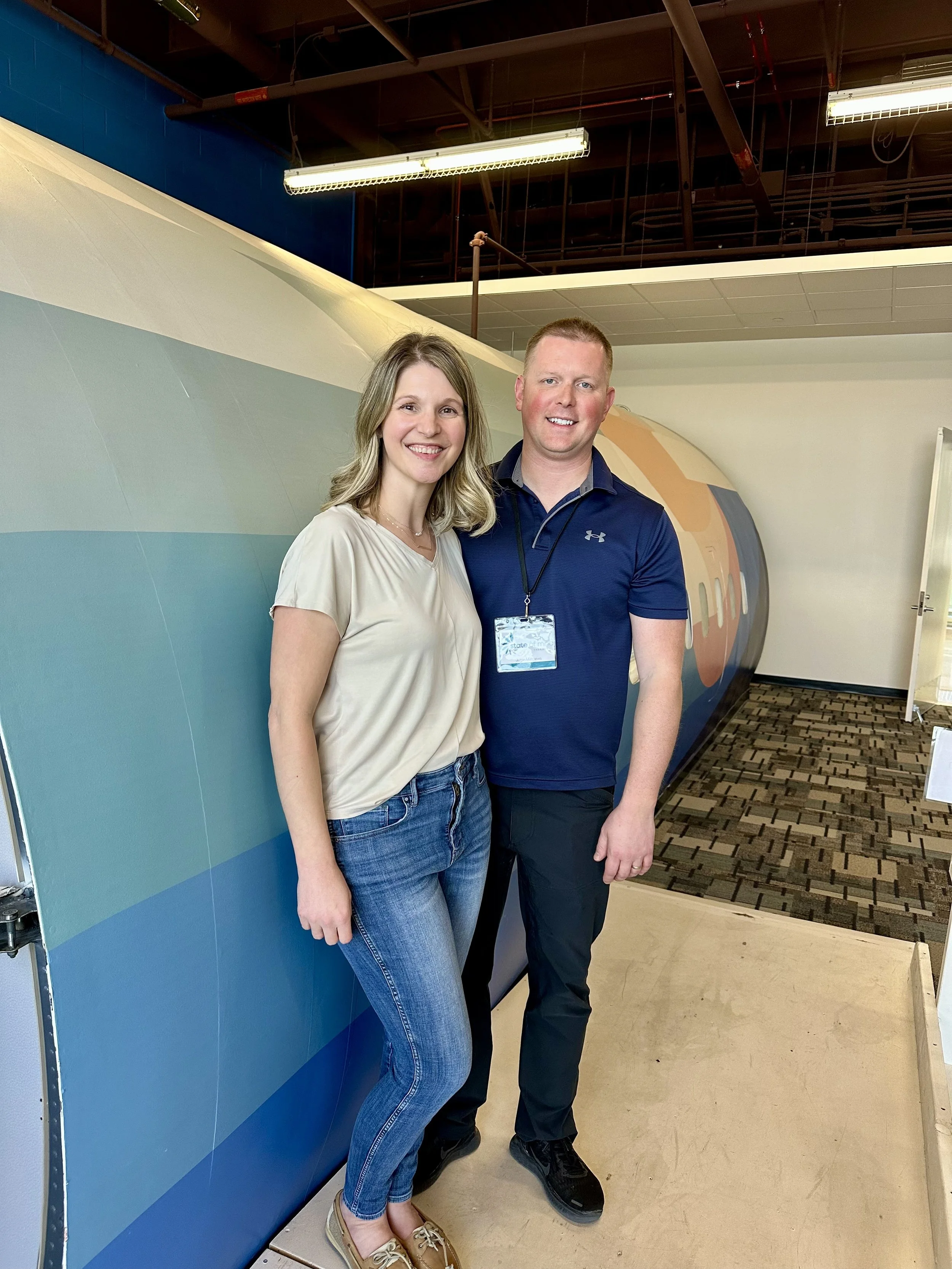
Inside Our MSP Airport Workshop: What Progress with Flight Anxiety Really Looks Like
When most people imagine someone struggling with flight anxiety, they picture obvious panic.
Shaking hands. Tears. Someone refusing to board the plane.
But after hosting another one of our fear of flying workshops at MSP Airport, we were reminded again that flight anxiety often looks much different than people expect.
Sometimes it looks like taking photos from the parking ramp because simply arriving at the airport feels overwhelming and stressful.
Sometimes it looks like noticing your anxiety rise while going through security or riding the tram.
Sometimes it looks like sitting on the plane with your eyes closed, grounding yourself while nobody around you realizes how hard you’re working internally.
And sometimes, it looks like showing up even though part of you still doubts whether flying will ever feel easier.
One of the most meaningful things about our MSP Airport Workshop is that people don’t have to hide those experiences. They get to practice being in the airport environment alongside other people who understand exactly what it feels like to fear flying.
And over and over again, we see the same important truth:
Progress with flight anxiety rarely looks perfect or linear.
The Biggest Misunderstanding About Flight Anxiety
Many people come to our workshop believing they need to figure out how to feel calm before they’ll be able to fly.
They think the goal is to eliminate anxiety, stop the physical sensations, or finally “logic” themselves out of fear.
But that’s usually not how progress actually works.
Instead, we help people learn how to respond differently to anxiety when it shows up.
Because anxiety itself is not the problem.
The problem is often what anxiety convinces people to do next:
avoid
escape
over-monitor sensations
seek reassurance
mentally fight with fear
decide anxiety means they can’t handle flying
At our workshop, people get the opportunity to practice staying engaged with the experience instead of automatically retreating from it.
That doesn’t mean anyone does it perfectly or without fear. But learning how to respond differently is what it’s all about.
One Attendee’s Experience: Stepping Off the Plane…Then Trying Again
During our recent workshop, we closed the aircraft doors for part of the experience so attendees could practice sitting with that part of flying if they chose to.
One attendee decided to step off the plane once the doors closed.
There was no pressure or judgment around that decision. In fact, part of the workshop is recognizing that everyone’s fear shows up differently.
As we talked afterward, she shared concerns about an upcoming flight and worries about how panic might affect her ability to travel again.
At one point, the conversation shifted toward the idea of taking future “practice flights.”
But instead of jumping several steps ahead, we gently brought the focus back to the present moment:
What if the practice could simply be trying again right now?
Not deciding about future flights or feeling calm. But taking one small step, right now, to get back on the plane and sit. Even if it’s just for one minute.
She was hesitant, but willing.
Eventually, she chose to re-board and remain on the aircraft while the doors were closed.
It wasn’t because the fear suddenly disappeared.
In fact, it was clear she still felt uncomfortable. At one point, she stood near the fan for cool air while working through the physical sensations that had surfaced for her.
For her, progress was getting back on the plane and allowing herself to feel the panic even though she initially didn’t want to.
Sometimes progress is simply staying a little longer than you did before.
Why Repeat Attendees Matter
One of the most encouraging parts of this workshop was seeing several repeat attendees return.
For some people, attending once is enough to help them feel more prepared to fly again.
For others, the workshop becomes something they revisit before upcoming trips as a way to refresh skills, rebuild confidence, and practice being back in the airport environment.
One attendee shared that this was the third time she had attended the workshop.
And this time, while sitting on the plane, she rated her anxiety as only a 3 out of 10 — the lowest it had ever been for her during the workshop experience.
What made that moment especially meaningful was remembering where she started.
During her very first workshop, getting onto the aircraft itself felt incredibly difficult. She needed time to pause, ground herself, and work up to boarding.
This time it looked different.
She still used grounding strategies.
She still closed her eyes at moments.
She still practiced responding intentionally to anxiety.
But she stayed engaged with the experience in a way that once felt much harder for her.
By the end of the workshop, she shared that she finally felt ready to book a flight.
Not because all fear had disappeared, but because she trusted herself more in the presence of anxiety.
That’s the kind of progress we care about most.
Sometimes the Hardest Part Isn’t the Plane
One attendee shared something surprising in their feedback after the workshop:
They expected sitting on the plane to be the hardest part. Instead, they noticed more anxiety while going through airport security.
Experiences like this are important because they remind people that flight anxiety is often much bigger than turbulence or being in the air.
For many fearful flyers, anxiety begins long before takeoff:
parking at the airport
entering the terminal
seeing security lines
hearing gate announcements
walking toward the aircraft
That’s part of why practicing in the actual airport environment can feel so valuable for attendees.
They’re not just imagining the experience from home.
They’re walking through it step-by-step while learning how to respond differently along the way.
The Power of Feeling Seen
Another theme we heard repeatedly throughout the workshop was how meaningful it felt to be around other people who truly understood.
One attendee shared that she was shocked by how many people raised their hands when discussing fear of having a panic attack on a plane.
For years, she thought she was one of the only people struggling with that fear.
Another repeat attendee shared that one of the most helpful parts of returning to the workshop each time is simply seeing other people “like him” in the room.
That sense of connection matters more than people realize.
Because many fearful flyers spend years believing:
everyone else flies easily
they’re overreacting
they should be able to “just get over it”
something is wrong with them for struggling
But flight anxiety is incredibly common.
And for many people, the fear is not actually about the plane crashing.
It’s about:
feeling trapped
panicking in public
losing control
not being able to escape uncomfortable sensations
When people realize others share those same fears, shame often begins to loosen its grip.
We Don’t Measure Success by Calm
One of the most important things we teach during our MSP Airport Workshop is this:
Success is not measured by whether you feel calm.
Success might look like:
realizing anxiety can rise without needing to immediately escape it
discovering you can stay engaged even while uncomfortable
learning that panic sensation feel more manageable than you thought
noticing your anxiety decreases over time with repeated practice
becoming more willing to experience uncertainty in order to keep moving toward your travel goals
recognizing that anxiety and capability can exist at the same time
Fearful flyers often assume they need to wait until anxiety disappears before moving forward.But many people discover something different:
Confidence is often built through practicing movement with discomfort present — not waiting for discomfort to fully disappear first.
That’s why we don’t expect attendees to be fearless.
We simply want them to leave with:
more understanding
more tools
more willingness
more confidence in their ability to respond differently when anxiety shows up
And for many people, that becomes the beginning of real change.
Looking Ahead
Since the workshop, several attendees have continued practicing flying and sharing updates with us on their progress.
Moments like that are incredibly meaningful to witness. Because people begin reconnecting with places, opportunities, and experiences that fear had started to shrink.
If you struggle with flight anxiety, you are not the only one.
And finding success to fly doesn’t happen overnight. But if you have willingness, community support, and the right tools, then it’s absolutely possible for you.
Interested in Our MSP Airport Workshop?
Our fear of flying workshop at MSP Airport is designed to help people better understand flight anxiety, practice responding differently to fear, and experience the airport environment alongside others who truly get it.
You can learn more about the workshop and join the waitlist for future events here.
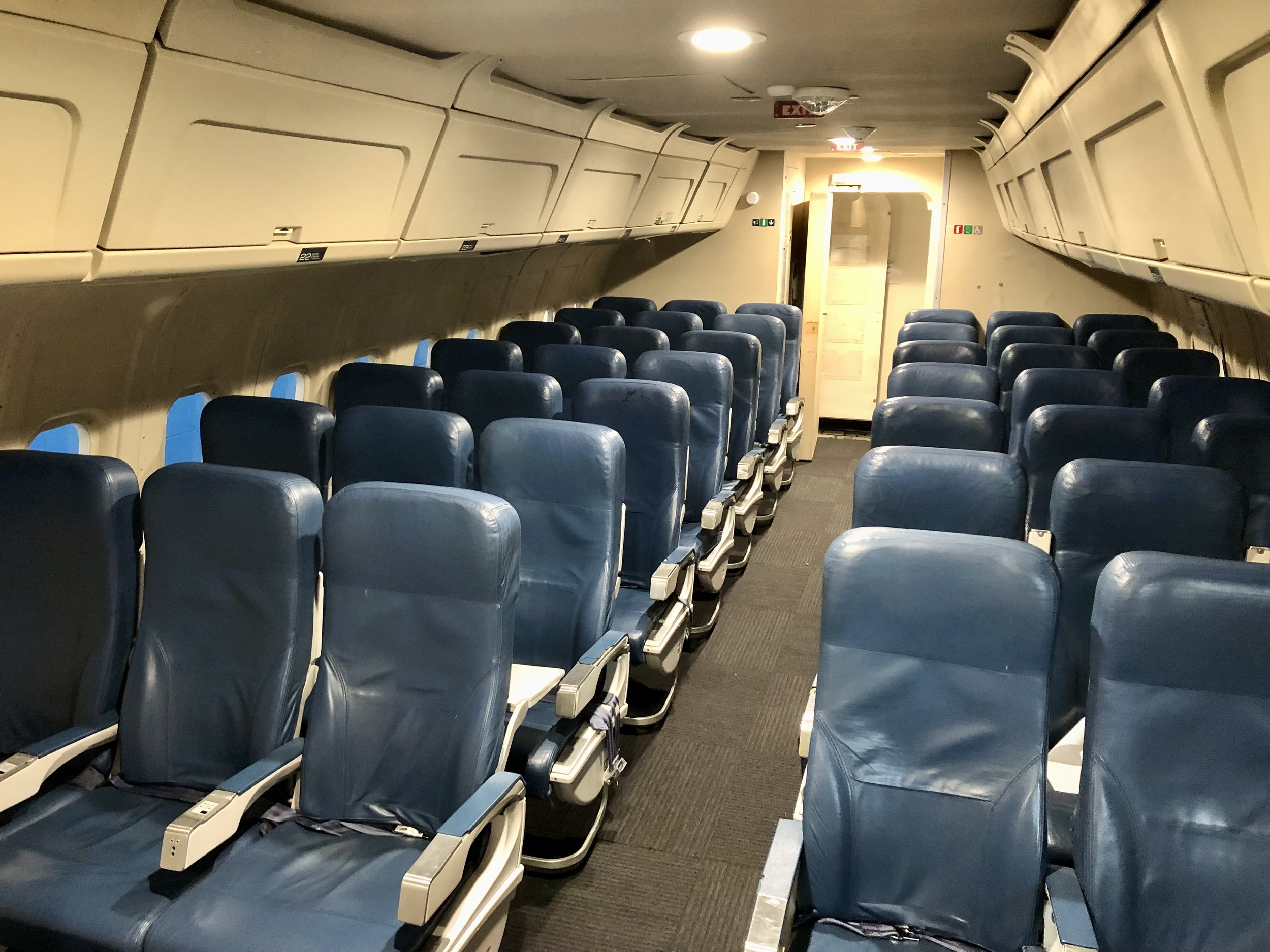
What I Notice at Our MSP Airport Workshop for Fear of Flying (And Why It Matters)
We just wrapped up our sixth workshop at MSP International Airport for anxious flyers.
And at this point, there are a few things I don’t even wonder about anymore because I see them every single time.
At the start of each workshop, we ask a simple question:
“How many of you are afraid of the plane crashing… versus something else?”
Almost every time, about 70% of people raise their hand for “something else.”
And while that number stands out, what matters more is what comes next.
Because even for the people who do say they’re afraid of the plane crashing, when we start talking more, there’s usually something underneath it.
It’s not just about what they believe to be the “worst case scenario.”.
It’s about the experience of being in it.
The uncertainty.
The lack of control.
The question of, “What if I can’t handle it?”
What Actually Shows Up
From the outside, fear of flying can look very different from person to person.
One person might be worried about turbulence.
Another about feeling trapped.
Another about getting sick on the plane.
Another about panicking and not being able to leave.
But underneath those different fears, there are a few common threads that connect almost everyone in the room.
Uncertainty. Lack of control. And a tendency to underestimate how well you’d actually cope if anxiety showed up.
I see this even in subtle ways.
Someone can look completely calm on the outside but when I check in with them, they’ll say something like, “I’m hanging in there.”
That’s often the reality of anxiety. It’s not always loud or visible…but it’s there.
What Surprises People the Most
One of the things I’ve come to witness each and every time is the shared connection participants feel when they are in a room full of others who get it.
Before the workshop even starts, there’s this moment where people look around are struck by how many people are there because they are struggling with the same fear and anxiety when it comes to flying.
I’ve had participants share that they felt emotional just seeing how many others experience the same fear.
And as the workshop goes on and people begin talking with each other and that feeling only grows.
Because while the specific fears may be different, the experience of anxiety is incredibly similar.
“What If Being Around Other Anxious People Makes It Worse?”
This is something I don’t always hear out loud but I know people think about it.
There’s often a concern that being around other anxious flyers will make things more intense…
or that the group will somehow feed off each other’s fear.
What I see, over and over again, is the opposite.
People feel more grounded.
More understood.
Less alone.
There’s something powerful about being in an environment where you don’t have to explain yourself.
Where people just get it.
And instead of anxiety escalating, what tends to happen is that people begin to settle into the experience because they’re not carrying it by themselves anymore.
Why This Matters
If your fear of flying feels very specific—like it’s about turbulence, or panic, or getting sick, or the plane itself—it can feel isolating.
Like your fear is different.
Like you’re the only one who reacts this way.
But what I see every time we run this workshop is that, at the core, people are navigating very similar challenges.
Uncertainty. Lack of control. And the belief that they won’t be able to handle what they feel.
And those are things that can actually be worked with.
Not by eliminating anxiety completely—but by changing how you relate to it.
If You’ve Been Thinking About It…
If you’ve ever thought about coming to something like this but felt unsure…
You’re not alone in that either.
People show up nervous. We’ve even had people who didn’t show up because it felt like too much. And many others were surprised by how much more confidence they grew from a practice run in an actual airport and sitting in a real aircraft.
Our MSP airport workshop is designed to give you the opportunity to be in that environment—to learn, observe, ask questions, and begin facing the fear in a way that feels manageable and supported.
And maybe most importantly, to see that you’re not the only one navigating this.
If you’ve been considering it, we’d love to have you join us at a future Navigating Flight Anxiety at MSP Airport event.
After a Rough Flight: When You’re Not Sure You Can Do It Again
You took the flight.
You got where you needed to go.
And instead of feeling relieved or proud, you feel exhausted. Discouraged. Maybe even a little defeated.
A lot of people who are anxious about flying will take a flight but have so much anxiety during it that they don’t know if they can keep doing it.
They might say “that was really hard…too hard.” Or “I don’t know if I can do that again.” or “Why does this feel like such a big deal for me?”
If that’s where you are right now, I see you. And keep reading to learn about how to not let your anxiety get the best of you when flying.
What People Usually Mean by a “Rough” Flight
When someone says they had a rough flight, they’re not always talking about the plane itself.
Sometimes the flight was turbulent.
Sometimes it was smooth.
What made it “rough” was the anxiety.
A rough flight might look like:
Feeling panicked or on edge the entire time
White-knuckling through takeoff, turbulence, or landing
Constantly monitoring your body for signs of panic
Crying quietly (or not so quietly)
Feeling stuck on the tarmac and counting the minutes
Never really relaxing for a second
From the outside, it may not have looked like you were struggling.
But on the inside, it was exhausting.
The Post-Flight Mental Spiral
After a rough flight, it’s very common for your mind to start spiraling.
Maybe you start thinking:
“That was awful.”
“I barely got through that.”
“What if next time is even worse?”
“I don’t think I can do that again.”
This is often the moment when anxiety starts telling a bigger story—one that goes beyond this flight and turns into questions about your future, your limits, or what this says about you.
That story can feel convincing, especially when you’re worn down.
Why Flying Again Doesn’t Always Make It Easier
Many people are surprised—and frustrated—to find that their fear of flying hasn’t improved, even though they’ve continued to take flights.
They’ll say things like,
“I’ve flown so many times. I’ve done exposure. And it never got better.”
What they’re usually describing isn’t exposure in a therapeutic sense—it’s endurance.
White-knuckling through flights, bracing for anxiety, monitoring every sensation, and just trying to “get through it” can absolutely prove that you can fly. But it doesn’t teach your nervous system that you can handle it.
In fact, when you endure a flight by staying on high alert the entire time, your body learns something very different:
This was dangerous, and I had to work extremely hard to survive it.
That’s why flying again doesn’t feel easier. You’re not failing at exposure—your nervous system just hasn’t had the chance to learn anything new yet.
Why White-Knuckling Leaves You Feeling Worse, Not Better
When you brace your way through a flight, you may get to your destination—but you also leave the experience feeling depleted.
You might logically know you “did it,” but you also know how miserable it felt.
For many people, that’s the real fear—not the plane itself, but the idea of having to endure hours of intense anxiety again, plus all the anticipatory anxiety leading up to it.
Enduring anxiety doesn’t build confidence.
It builds avoidance.
What a Rough Flight Does Not Mean
A rough flight does not mean:
You’re back at square one
You’ll always feel this way when you fly
You’ve failed
This anxiety will never change
It means your nervous system worked very hard—and it didn’t yet have the tools it needed to respond differently.
One difficult experience doesn’t define your future relationship with flying.
Using This Moment Differently
As uncomfortable as this moment is, it’s often an important one.
For many people, a rough flight is the point where they realize:
I don’t want this to keep controlling my life.
I want travel to feel different than this.
I might need more than willpower or white-knuckling.
That realization isn’t a failure. It’s information.
It can be the moment where the question shifts from “how do I force myself to get through this?” to “what do I need so this doesn’t have to feel this way next time?”
Everything about this is workable.
If You’ve Made Progress with Flying Anxiety Before
If flying has felt more manageable in the past and this flight felt especially hard, that doesn’t erase the progress you’ve made.
Flying is a unique fear because most people don’t do it often enough for confidence to build consistently. Old anxiety responses can resurface easily, especially after a stressful experience.
Setbacks happen. They’re part of the process—not proof that things aren’t working.
Closing Thought
If you’ve just had a rough flight and are feeling unsure about the future, this doesn’t mean you’re stuck like this forever.
It means your anxiety is asking for something different—different skills, different support, a different way of responding.
And that is possible.
If you want help learning how to change your relationship with flying anxiety—so future flights don’t have to feel this overwhelming—we invite you to work with us.
We help people learn how to fly with more peace and confidence through various ways, such as individual therapy, on demand courses, and in-person workshops to help you learn how to fly with more peace.
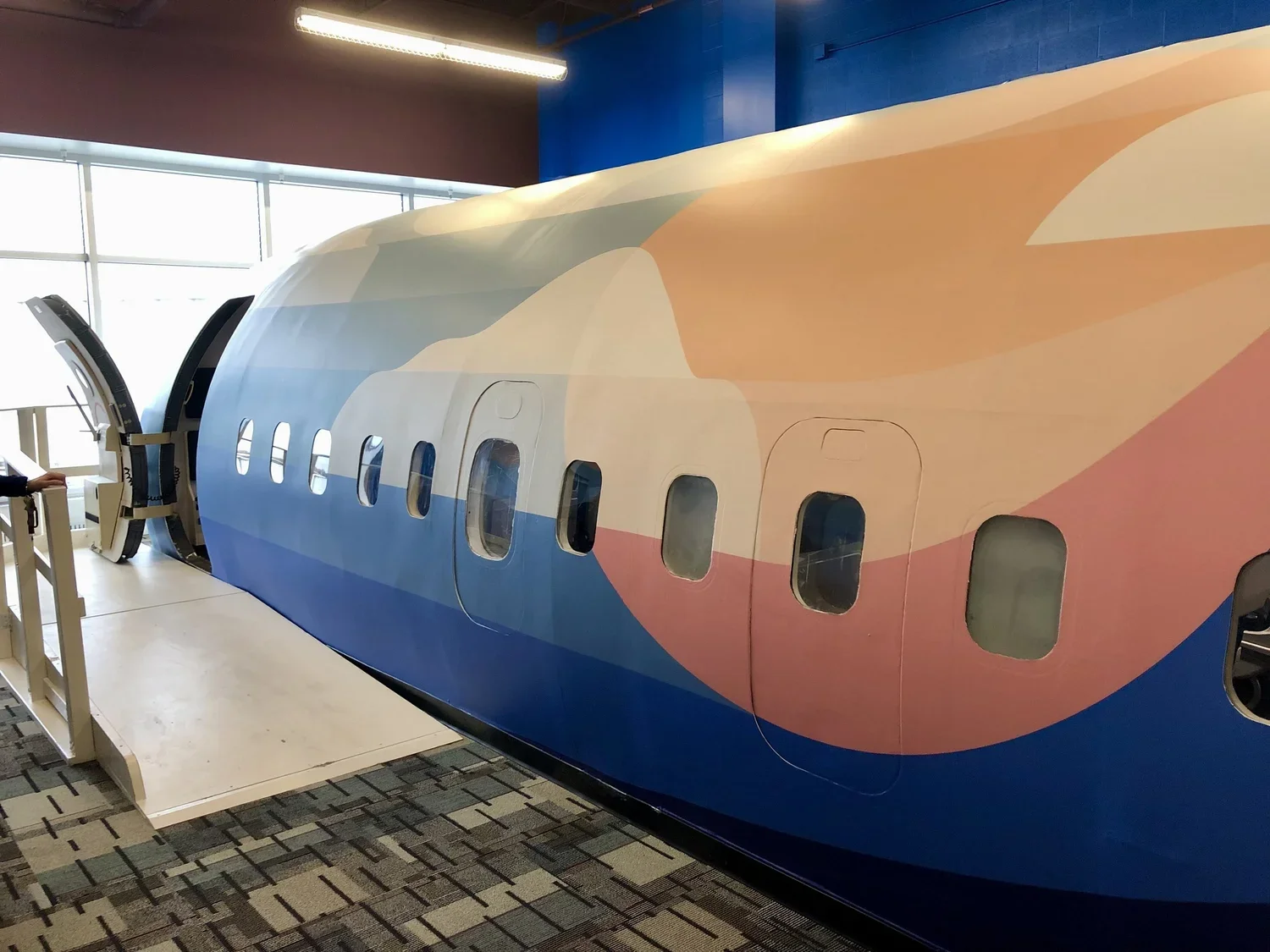
What I Noticed at the MSP Fear of Flying Workshop
After our most recent Fear of Flying workshop at MSP Airport, I found myself reflecting on the experience — not just this one event, but the shared experiences that show up every single time we offer this workshop.
What stands out most is how powerful the environment itself is.
Being in the airport, walking through security, and sitting on a plane while learning anxiety management skills is something that simply can’t be replicated in a Zoom meeting or a conference room.
Even though everyone knew we weren’t actually going anywhere, stepping onto a plane — sitting in the seats, closing the doors, staying — was a big step. For some participants, that alone brought up strong emotions.
Just Being There Was the Exposure
One of the most powerful parts of the workshop was seeing how emotional some people became just sitting on the plane.
Not because we were flying anywhere. Not because we were taking off. But because their nervous systems were responding to the experience of being there.
This is something anxious flyers often minimize or judge themselves for:
“I’m not even flying — why is this so hard?” But it makes complete sense.
For someone who fears flying or being trapped, simply placing your body in that environment can activate the alarm system. And because we aren’t flying anywhere, it gives people a chance to stay with those feelings and see that they are safe to have.
“It Feels Good to Not Feel So Alone”
Another thing that stood out was how quickly people connected with one another.
Over and over, participants commented on how relieving it felt to hear others describe the same fears:
The fear of being stuck
The fear of panicking with no way out
The frustration of knowing flying is safe but still feeling overwhelmed
Flight anxiety can be deeply isolating. Many people feel embarrassed by it or assume they’re the only ones who react this way.
Watching people realize, “Oh — it’s not just me,” is incredibly powerful.
That sense of shared understanding often brings relief before any technique ever does.
Two Different Fears — One Shared Struggle
Something I notice in nearly every workshop — and this one was no exception — is that participants often fall into two groups.
About half are primarily afraid of the plane crashing. The other half aren’t worried about crashing at all. Their fear is more about:
Feeling trapped
Being stuck for hours
Not being able to leave if they start to panic
Different fears — but the same underlying struggle with uncertainty, loss of control, and bodily anxiety.
Understanding what you’re actually afraid of matters, because it shapes how you work on the fear. Many people don’t realize until they’re in a space like this that flying itself isn’t the real problem.
A Moment of Confidence That Matters
At the end of the workshop, one participant shared something that really stuck with me.
They said they felt like they could get on a plane that day.
Not because their anxiety was gone. Not because flying suddenly felt easy. But because they felt more capable.
That’s what real progress usually looks like. Not the absence of fear — but a shift in how much power it has over you.
What I Wish More Anxious Flyers Knew
If there’s one thing I wish more anxious flyers understood, it’s this:
This fear is workable.
Not in a “just push through it” way — but in a real, lasting way.
During the workshop, my husband shared something personal with the group. Years ago, he struggled with panic disorder and agoraphobia. Today, that’s no longer something that runs his life.
I also shared my own experience. I once had a fear of flying myself. Now, flying is something I do regularly. I plan trips intentionally. I keep practicing. I don’t wait for fear to disappear before living my life.
That distinction matters.
Skills Help You Get Through the Moment — But They Don’t Change the Fear
There’s a place for in-the-moment coping skills like distraction and deep breathing. If you have tools that help you get through an upcoming flight, that’s important — especially if you haven’t done the deeper work yet.
But skills alone don’t change the fear.
They help you survive the moment — not retrain your nervous system.
Lasting change comes from learning how to stay with discomfort, reduce avoidance, and teach your brain that flying isn’t an emergency it needs to protect you from.
That’s the work we focus on — not just helping people “get through” a flight, but helping the fear itself lose its grip over time.
Change doesn’t happen overnight, but it does happen when fear is worked with intentionally, gradually, and with the right support.
Closing Thoughts
Our Navigating Flight Anxiety Workshop helps others learn that fear of flying isn’t about willpower or logic. (If it were, you would have solved it by now.)
It’s about willingness, commitment, and realizing you’re not alone.
If you’ve been avoiding flights, dreading upcoming travel, or feeling overwhelmed by the thought of being stuck on a plane, support can make a difference — whether that’s through therapy, workshops, or guided programs designed specifically for flight anxiety.
Click here to learn more about our in-person workshop at the MSP Airport.

When Plane Crash Headlines Shake You: Why Logic Isn’t Enough to Calm Flight Anxiety
You were doing okay.
You had a trip coming up. You were starting to feel a little more confident about flying. Maybe you’d even taken some real steps forward—researching fear of flying courses, practicing coping skills, or booking a flight you’d been putting off.
And then… that headline.
Maybe it was the recent crash in India. Or maybe it was another story that suddenly popped into your feed.
Either way, your brain did what anxious brains do:
“See? This is exactly why I shouldn’t fly.”
Even if you know flying is statistically safe, logic doesn’t seem to help anymore. You’re stuck between what you know and what you feel—and now your anxiety has evidence.
If that’s where you are right now, then it’s important for you to know that this does not have to mean you are stuck. Keep reading to learn more.
Let’s talk about what’s really going on when anxiety hijacks your progress, and how you can move through it without spiraling into avoidance.
1. Recognize the Spiral (It’s Not Proof—It’s Your Brain Doing Its Job)
When a rare event confirms your worst-case scenario, your brain zeroes in.
That’s called confirmation bias. Which means your mind selectively looks for things that match what you already fear and ignores the rest.
So after a crash, your thoughts might race:
“See? I knew it wasn’t safe.”
“Now I really can’t fly.”
But that’s only one story..
This fear makes sense. And it doesn’t have to be the only story you listen to.
What else is true?
Over 70,000 commercial flights took off and landed safely that same day. Your fear is valid—but it’s not the full picture.
2. Let Yourself Feel (Without Letting Fear Take Over)
Yes, it’s upsetting. Yes, it's scary. And yes, your anxiety spikes when something like this happens. That doesn’t mean you’re stuck and can’t get through this. It means you're human, and your brain is trying to protect you.
Try saying to yourself:
“I feel scared right now, and that’s okay.”
“This news is upsetting, but I don’t have to change my plans.”
Feeling fear doesn’t mean you have to act on it. You can feel anxious and keep moving toward your goals.
3. Be Mindful of the Headlines You Feed Your Brain
Anxiety wants certainty.
It makes you think, “If I can just learn what happened, I’ll be able to avoid it next time.”
So you start down an internet rabbit hole reading all the articles, watching videos, and commenting in forums. You want to understand it all so you can feel safe again. But what happens instead?
You feel worse.
You get pulled into speculation and clickbait. Most early news coverage after a crash is emotional, attention-grabbing, and not based on facts. You’re left swimming in what-ifs and fear-driven commentary.
Meanwhile, the algorithm is watching.
Now you’re being fed more and more aviation content: past crashes, speculative theories, safety debates. It feels like crashes are everywhere—even though nothing in the real world has changed.
It might seem like you’re just reading stories…but what you’re doing is accidentally training your brain (and your browser) to stay stuck in fear.
And here's what makes it even harder: this spiral doesn’t actually offer clarity. It just floods your nervous system, increasing the obsession without reducing the anxiety.
Instead of clarity, you get consumed.
Instead of peace, you feel paralyzed.
So here’s your reminder:
Learning doesn’t help when you’re dysregulated. Wait until you're grounded and have allowed time to pass to get the facts.
4. Don’t Start Making New “Safety Rules”
This one’s sneaky.
After a crash, it’s natural to want to regain control. So your brain might offer rules like:
“Only fly this airline.”
“Only sit in the back.”
“That one guy survived in 11A—I’ll only sit there from now on.”
These rules might give temporary relief. But long-term, they reinforce the idea that flying is only safe if you do everything perfectly—which keeps you anxious and locked in control-based thinking.
And the truth is? That seat didn’t save him.
Survival in accidents is often random and unpredictable. Trying to replicate outcomes doesn’t make you safer. And it just feeds the illusion of control.
True progress means moving away from control and toward trust—in yourself, your skills, and your resilience.
Why Logic Isn’t Helping (And What to Do Instead)
If you’ve been telling yourself,
“I know flying is safe. I’ve seen the stats. But now this happened and I can’t stop thinking about it,”
…then you already know: logic isn’t enough.
Most people with flight anxiety are highly intelligent. You already know the facts.
But when fear shows up, logic alone can’t compete with the emotional part of your brain.
You get stuck in the tug-of-war between your desire to travel and your brain screaming “Don’t do it.”
This is where most people give up.
But this is actually where healing begins.
What NOT to Do After a Plane Crash Makes Headlines
Let’s be honest—there are a few things your brain really wants to do after seeing a scary aviation headline. And they all feel helpful in the moment... but usually make things worse.
Here’s what to avoid:
Don’t fall down the research rabbit hole.
You’re not getting facts—you’re getting fear.
Don’t cancel your trip out of panic.
Decide from a regulated place, not a reactive one.
Don’t compare crash survival stories.
Trying to mimic someone else's outcome won’t bring certainty—just more anxiety.
Don’t create rigid flying “rules” to protect yourself.
They don’t actually make you safer—they just shrink your world.
Instead? Step away from the media. Breathe. Reconnect with your why for flying in the first place.
What to Say to Yourself Instead
When fear is loud and facts aren’t landing, try gently shifting the way you talk to yourself.
Here are a few self-talk statements I teach my clients to practice:
✨ “This fear makes sense right now. It’s okay that I’m feeling this way.”
✨ “Yes, something scary happened—and thousands of flights are happening safely today too.”
✨ “Just because I’m anxious doesn’t mean I’m in danger.”
✨ “I’ve gotten through tough moments before. I can ride this wave too.”
✨ “I don’t have to wait for the fear to go away before I move forward.”
✨ “There’s still a part of me that wants to travel and live fully—I can listen to that part too.”
Self-talk isn’t about tricking yourself into calm—it’s about creating a little space between you and the fear. Enough space to choose what happens next.
If That’s Where You Are, You’re Not Broken—You’re Ready for a New Approach
This is the exact moment where the real work begins—not trying to erase the fear, but learning how to move forward with it.
In the Fearful Flyers Blueprint, that’s what we focus on.
You’ll learn how to:
Respond when anxiety spikes—even after scary headlines
Stop relying on logic and start building trust in your ability to ride the waves of fear
Take action even when you’re uncomfortable (because that’s how confidence is built)
It’s not about eliminating anxiety. It’s about learning how to stop running from it.
Final Thoughts
These moments are hard. The fear is loud. The headlines are heavy.
But you are capable of more than just white-knuckling it through.
You don’t have to wait until you feel fearless.
You don’t have to cancel your trip just because anxiety showed up again.
It’s okay to feel anxious and still show up for the life you want.
You’re capable of more than just surviving the flight—you can learn to thrive through it.
Want to Start Handling Fear Differently?
If you’re tired of relying on logic and reassurance that doesn’t stick, and you're ready to learn the skills that actually help—start the Fearful Flyers Blueprint to change how you experience flying.

Flying Soon? Here’s How to Calm Last-Minute Flight Anxiety
Spring break is here, and if you’re flying in the next few days, you might be feeling the pre-flight anxiety kicking in.
Maybe your mind is racing with thoughts about turbulence, delays, feeling trapped, or panicking mid-flight. Maybe you’re struggling to sleep the night before your flight or feeling like you just won’t be able to relax until you land.
I get it. The days leading up to a flight can be just as stressful as flying itself.
But here’s the thing—anticipation anxiety distorts reality. The fear you feel before flying often has nothing to do with the flight itself and everything to do with the worst-case scenarios playing out in your mind.
If that’s happening to you, you’re not alone. And the good news? You don’t have to spend the next few days stuck in an anxious spiral.
Let’s talk about why flight anxiety feels so intense before you even step foot on the plane—and what you can do to shift it.
Stop Trying to ‘Convince’ Yourself to Feel Calm
A lot of anxious flyers spend the days before a flight trying to force themselves to feel calm. They tell themselves, "If I can just think positively, I won’t feel anxious," or they look for reassurance that everything will be okay.
But that rarely works.
In fact, the harder you try to force calm, the stronger anxiety tends to get. When your brain is stuck on high alert, the goal isn’t to eliminate anxiety—it’s to stop feeding it.
This is something I help my students understand inside my course, Calm Before Takeoff. Most people think they need to make their anxiety disappear before flying, but the real shift comes when you stop seeing it as something to fight.
Why the Days Before a Flight Feel Worse Than the Flight Itself
The hardest part of flight anxiety often isn’t the flight itself—it’s the waiting.
When you have days (or weeks) to sit with anxious thoughts, your brain starts playing out every possible worst-case scenario. You imagine turbulence, delays, feeling trapped, losing control. And because the brain reacts to imagined fear the same way it reacts to real danger, the stress feels overwhelming.
That’s why so many anxious flyers experience trouble sleeping, loss of appetite, or physical symptoms leading up to their trip. It’s not because something bad is about to happen—it’s because your nervous system is on overdrive, trying to prepare for something that hasn’t even happened yet.
This is a huge part of what we work on inside Calm Before Takeoff. Anticipation anxiety makes your fear feel bigger than it really is, but there are ways to shift out of that spiral so it doesn’t take over.
Reframing the Unknown: What If You Don’t Need Certainty?
One of the hardest parts of flying is not knowing what to expect.
Will my flight be delayed?
Will we hit turbulence?
Will I feel trapped on the plane?
Your brain craves certainty, so it fixates on these questions—trying to prepare for every possible scenario.
But flying is unpredictable. No amount of planning will guarantee a perfectly smooth experience. That’s why the real skill isn’t finding ways to control the unknown—it’s learning how to handle uncertainty without spiraling.
Inside Calm Before Takeoff, I teach a simple mental shift that helps my students stop clinging to certainty. Because the truth is, you don’t need to predict the future to manage your anxiety. You just need to know how to respond to it in a way that keeps you feeling in control.
What If You Panic on the Plane?
A huge fear for anxious flyers is: What if I panic mid-flight and can’t escape?
But here’s something to remember—panic attacks don’t last forever. In fact, no feeling does.
Most people make the mistake of trying to “stop” panic when it shows up. They resist it, brace against it, or tell themselves they can’t handle it. But that only makes it worse.
One of the biggest mindset shifts I teach inside Calm Before Takeoff is that panic isn’t something you need to fight. The moment you stop treating it like an emergency, it starts to lose its power.
The Night Before: Get Out of Your Head & Into Your Body
If your anxiety is spiking the night before your flight, focus on shifting your energy away from overthinking and into something grounding.
Going for a short walk, using relaxation techniques, or even distracting yourself with a simple task can help. The key is to keep your brain from getting stuck in an anxious loop.
This is something I cover in detail inside my course—I break down simple self-care strategies to help you feel more grounded and in control before you even step foot in the airport.
Want More Support Before Takeoff?
If you’re struggling with pre-flight anxiety, my mini course, Calm Before Takeoff: Crush Anticipation Anxiety Before Your Next Flight, was designed for you.
It’s an audio-based mini course you can listen to while packing or driving to the airport, with practical strategies to help you feel more in control in the days leading up to your flight.
Inside, you’ll learn:
Why anticipation anxiety feels so overwhelming (and how to stop spiraling)
A science-backed mindset shift that makes flying feel less stressful
What to do if anxiety spikes before or during your flight
Click here to access Calm Before Takeoff and take the stress out of your upcoming trip.
If You’re Flying Soon, Remember….You’ve Got This.
If you’re getting on a plane in the next few days, remember this:
You don’t have to love flying to handle it. Your anxiety doesn’t predict reality. You’re capable of more than your fear tells you.
Take it one step at a time. You’ve got this.

Overcoming Flight Anxiety When Claustrophobia Takes Control
You've booked your dream vacation, the destination is perfect, and the itinerary is exciting. But then, reality hits you—the thought of getting on that plane sends a rush of fear through your body.
The idea of being trapped, the doors shutting, and not being able to get out makes you feel like canceling the whole trip.
If this sounds familiar, you're not alone. Many people struggle with flight anxiety related to claustrophobia. But the good news is, there are ways to manage this fear and take back control.
Understanding Claustrophobia in the Context of Flying
It’s often misunderstood that fearful flyers are worried about the plane crashing. But there are many other reasons people fear flying.
One reason is claustrophobia, or the fear of being trapped in small spaces. For some, the fear rushes in the moment the doors close and there's no way out.
Others fear being held on the tarmac for hours. The thought of being confined without control over their environment can lead to an overwhelming sense of panic. Or maybe you worry about losing control of yourself and doing something embarrassing on the flight.
If you are looking for support while flying with Claustrophobia, it’s important to know that there are “in the moment” tips for flying and longer-term strategies that can help you become less fearful in small spaces (like flying). This blog will cover examples of both.
Mental Preparation
1. Reframe Your Thoughts: Stop telling yourself that you are stuck on this plane or trapped. Remember, you are CHOOSING to go on this flight. When the plane doors close, think of it as the step to getting where you need to go, not confinement.
2. Bust the Illusion of Control: In many areas of life, we accept things outside our control without much thought. Accepting that you don’t have to control everything can reduce the pressure you put on yourself and help manage your anxiety.
In-Flight Tips
1. Book an Aisle Seat: Having an aisle seat can provide a sense of space and control, making it easier to move around and lessening the feeling of being trapped.
2. Shift Your Perception of Space: Notice the space you do have on the plane. Notice the openness of the aisle, the space around your seat, and the environment outside the window. On a plane, you are free to move around….unlike in a car.
3. Controlled Breathing: Practice deep breathing exercises to calm your nervous system. Inhale slowly through your nose, hold for a few seconds, and exhale through your mouth.
Face Your Fear of Claustrophobia with Exposure
The most effective way to overcome your fear in the long run is to face your fears in small steps over and over again.
When you repeatedly practice facing your fear, your brain starts to "get used to it" and stops firing off the danger alarm. It will start to recognize flying as low risk and stop trying to warn you of danger.
One of the challenges with exposure and flight anxiety is that many people don't fly frequently enough, so that can make it more challenging to practice.
And it doesn't help that flying is expensive, which can keep people from practicing frequently. However, there are ways around this, and working with a professional can help design exposure exercises that can be done even without buying a plane ticket.
Sample Exposures for Fear of Feeling Trapped
Spend time in small, enclosed spaces like a bathroom stall or elevator.
Sit in the back seat of a car for a short drive.
Practice closing the door and staying in a room for a set period.
Take short flights, gradually increasing the duration.
These are just a few examples of exposures. A therapist trained in exposure therapy will help create a personalized exposure menu that targets the right activities and guides the pace for the best results.
Conclusion
Flight anxiety related to claustrophobia can feel overwhelming, but with the right strategies and support, you can manage it effectively. Remember, you're not alone and you don’t have to figure this out on your own. Therapists trained in CBT and exposure therapy can provide personalized guidance to help you overcome your fear.
Need More Support With Your Fear of Flying?
If the fear of feeling trapped is making you dread your next flight—or consider canceling it altogether—know that there’s a way forward.
Inside my online course, Fearful Flyers Blueprint, I walk you step-by-step through exactly how to manage panic, shift your attention, and retrain your brain so flying doesn’t feel like a trap. You’ll learn how to handle that moment when the doors close—without spiraling.